n 1943 Poland’s wartime leader accused Moscow of ordering the Katyn massacre, the systematic murder of 22,000 Polish officers and intellectuals. A few months later he was dead, the victim of an air crash. Was it murder? Almost certainly not, but Poland’s painful past, combined with official secrecy, created precisely the muggy and mysterious conditions in which conspiracy theory thrives.
In 2010 another Polish leader, President Lech Kaczynski, heads to Katyn to commemorate the appalling massacre that took place there. Within hours he too is dead, along with his wife and 94 other members of Poland’s elite, the victims of another air crash. Was this coincidence? Almost certainly, but a similar climate of suspicion ensures that the conspiracies are already sprouting, and spreading.
The thread connecting these events is secrecy, for it is concealment that turns a tragedy into a festering historical sore. Britain still has not released all the files on the death in 1943 of General Wladyslaw Sikorski, Prime Minister of the Polish Government-in-exile. For decades Moscow declined to admit what had happened at Katyn, and Vladimir Putin still refuses to apologise.
In the confusion and grief following the Smolensk air crash on Saturday, the whispers, rumours and accusations have begun to circulate. The Polish president’s plane, it is noted darkly, was Russian-made, and recently serviced in Russia. The Russian Government heartily disliked President Kaczynski, who had criticised Russia’s “new imperialism”. Moscow declined to invite him to a ceremony at Katyn last Wednesday — so Kaczynski decided to hold a second memorial service, and was killed en route.
Initial reports have ruled out mechanical failure, so was the pilot pressurised to make the landing by his august passengers? Polish conspiracists are already blaming the Russian secret service, while others suggest that Russian hardliners may have sought to undermine Mr Putin by sabotaging the plane.
Poland has a deeply emotional, almost mystical relationship with the story of tragedy, rebellion, courage and repression that is Polish history. The present is permanently refracted through the past. “The place is cursed,” declared Aleksander Kwasniewski, the former President, after the latest tragedy associated with Katyn.
Lech Walesa’s remark was even more telling: “This is the second Katyn tragedy; the first time they tried to cut our head off, and now again the elite of our country has perished.” Implicit is the assumption that “they”, unnamed enemies, must also lie behind Poland’s latest national calamity.
The only way to ensure against wild conspiracy theories is to conduct the crash investigation in the disinfecting sunlight; to eschew the secrecy that is Moscow’s natural instinct; and to ensure that the historical verdict on this episode is provided, or at least believed, by Poles. To do, in short, everything that Britain failed to do when investigating the death of another Polish leader, 67 years ago.
On July 4, 1943, General Sikorski, the Polish commander-in-chief of land under Nazi occupation, took off from Gibraltar in a converted RAF Liberator bomber, bound for England. A few minutes later the plane plummeted into the harbour, killing 16 passengers on board including Sikorski’s daughter, Zofia. The Czech pilot was the sole survivor.
A British court of inquiry conducted a swift and secret investigation, which ruled out sabotage but failed to establish the cause of the crash. The pilot said his controls had jammed.
The conspiracy theories erupted almost immediately, and have continued ever since. One held that the Nazis had orchestrated the crash, determined to remove a popular Polish figurehead. Even greater suspicion fell on Stalin, who had most to gain from eliminating the troublesome general. Three months earlier Sikorski had called for a Red Cross investigation into the Katyn massacres, prompting a furious Stalin to break off relations with the Polish Government-in-exile.
Alternative theories claimed that the assassination was the work of a Polish faction, or the British, keen to remove an impediment to good relations with its Soviet ally. Soldiers, a 1968 play by the German playwright Rolf Hochhuth, even suggested that Winston Churchill had played a role in the supposed assassination plot.
Many British documents relating to the crash remain classified, and for nearly seven decades the conspiracists have been allowed virtually free rein. Kim Philby, then head of MI6 counterintelligence for the Iberian Peninsula, was said to have had a hand in organising Sikorski’s death on behalf of his Moscow spymasters. Sikorski’s daughter was allegedly spotted in a Soviet gulag many years later. Sikorski himself was variously said to have been poisoned, strangled, suffocated or shot before being loaded on to the doomed plane.
Last year Polish forensic scientists exhumed the general’s corpse from a crypt in Cracow and concluded that he had died in the air crash after all. But, as Polish historians pointed out at the time, until or unless all the British and Soviet archives are released, the fate of Poland’s wartime leader will continue to be a source of friction and fantasy.
Sikorski’s plane probably crashed because someone accidentally placed luggage on the steering mechanism. An equally simple explanation — most likely pilot error — may lie behind the accident that deprived Poland of so much of its leadership last weekend.
If so, it is essential that the Polish people themselves see the truth being revealed. So far, Russia has made the right noises, promising an open investigation and agreeing to leave the aircraft at the scene.
But so long as Mr Putin heads the commission investigating the crash, Poles will wonder about the truth of its findings. Russia should invite Polish experts to take part in, and witness, every aspect of the investigation. Mr Putin has gone some way towards building a historical consensus about Katyn, even making a personal appearance at the service last week. This is another opportunity for him to demonstrate that history, as it unfolds, can bring old enemies together, as well as force them apart.
Like the Katyn massacre and the death of General Sikorski, the Smolensk crash will come to represent another tragic milestone in Poland’s history. The horror of Katyn was hidden for half a century behind Soviet lies; the fate of Sikorski was obscured, for far too long, by British secrecy. This time Poland itself should have the right to decide what really happened.
Source:Times online

Showing posts with label Russia and Poland. Show all posts
Showing posts with label Russia and Poland. Show all posts
Monday, April 12, 2010


Mystery still surrounds cause of Polish air tragedy

Russian authorities confirmed yesterday that they had identified the body of Polish first lady Maria Kaczynska, who died along with her husband and 94 others in the air crash near the western Russian town of Smolensk.
Her remains will be flown home today, a day after those of Mr Kaczynski. The deceased president will lie in state from today at the presidential palace in Warsaw ahead of a state funeral on Saturday.
Mystery persists about why the aircraft clipped trees and crashed in flames after Russian tests yesterday revealed no mechanical defects.
Polish authorities say the aircraft had been fitted recently with new electronic equipment and the engine had been overhauled. But diplomats familiar with the aircraft have questioned why Warsaw still used a Soviet-built Tupolev 154 “badly in need of replacement”.
“It’s hard to understand how we are involved in costly missions in Afghanistan and Iraq but are unable for years to equip our [leaders] with proper planes,” said Prof Roman Kuzniar, an international affairs analyst at Warsaw University.
That has all turned the spotlight back on Mr Kaczynski. Asked whether the pilot was pressurised to land by the president, Poland’s chief prosecutor, Andrzej Seremet, said yesterday: “At the current level of the investigation we have no such information.”
After flight recorders revealed nothing unusual, Russian investigators said yesterday they had moved on to the voice recorders.
Mindful of the continuing week of mourning, Polish media have not dared even raise the possibility that Mr Kaczynski had a role in the crash. But the Russian media have recalled how, in 2008, Mr Kaczynski demanded that a pilot land his aircraft in Tblisi in the middle of the Georgian war; the pilot refused and diverted.
A Russian flight expert suggested in the Komsomolskaya Pravda daily that the crash was caused by “VIP passenger syndrome”. But this was dismissed by a colleague of Arkadiusz Protasiuk, the crash pilot.
“He was a tough man who wouldn’t let emotions prevail over common sense,” said Tomasz Pietrzak, another government pilot, on Polish radio. “He would certainly not risk passengers’ lives.”
The crash has also prompted reflection in political circles about whether the incident might have been the indirect consequence of years of competition between the president and Polish prime minister Donal Tusk.
Last Wednesday, Mr Tusk flew to Katyn for a memorial service with his Russian counterpart, Vladimir Putin. Feeling snubbed at not being invited, Mr Kaczynski, from a competing party, organised a competing event on Saturday to remember the 22,000 Polish soldiers massacred at Katyn in 1940.
“As a consequence of the crash, this unfortunate situation may finally be at an end,” said Andrzej Maciejewski, political analyst of the Sobieski Institute think tank.
Mr Kaczynski’s office published his final, undelivered speech yesterday, in which he paid tribute to the Katyn soldiers and the families who kept their memory alive, and condemned the Soviet cover-up as “the founding lie of the [communist] People’s Republic of Poland”. But the president, known for his anti-Russian tirades, saved his final words to thank Moscow for its assistance ahead of the 70th anniversary of the Katyn massacre.
The undelivered words carry additional poignancy now: “Let’s allow the Katyn wound to finally heal,” he planned to say. “We are already on the path; we should follow it to bring our nations closer and not stop or retreat.”
Mr Maciejewski of the Sobieski Institute said: “In future we will be able to distinguish between pre-April 10th Polish-Russian relations and post-April 10th.”
Source: Irishtimes
'VIP passenger syndrome' may have contributed to Polish plane crash

Black box recordings have confirmed that the pilot, Arkadiusz Protasiuk, an experience airman serving with the Polish air force, had ignored warnings to divert to another airport because of heavy fog.
However, it has been suggested that Mr Kaczynski did not want to miss a ceremony for the 22,000 Poles massacred by Soviet forces in the Second World War and may have urged the air crew to continue trying to land the plane.
Viktor Timoshkin, an aviation expert, said: "It was quite obviously 'VIP passenger syndrome'. Controllers suggested that the aircraft's crew divert the plane to an alternate route. I am sure that the commander of the crew reported this to the president. But in response, for whatever reasons, he had a clear order to land."
In August 2008, Mr Kaczynski "shouted furiously" at a pilot who had disobeyed his order to land his plane in then war-torn Georgia for safety reasons. He later tried to have Captain Grzegorz Pietuczak removed from his post with the Polish air force for insubordination, however, Donald Tusk, the Prime Minister intervened. Captain Pietuczak was later awarded a medal for carrying out his duties conscientiously for his refusal to land having judged the risks.
A Russian aviation expert said yesterday: "If he tried to land three times and fell on the fourth then he probably had the 2008 incident in mind and that was why he felt he had to land at any price. In effect, he did not take the decision but the main passenger on board did - even if the main passenger did not utter a word to the pilot."
Andrzej Seremet, Poland's chief prosecutor, said that there was no information from the investigation so far to suggest that Mr Kaczynski had put undue pressure on the pilot.
A senior air traffic controller at the Russian airport where the Polish plane was trying to land stirred controversy by suggesting that the Polish pilots' poor knowledge of the Russian language was to blame.
"They were supposed to give us a report about their altitude on the approach to landing," he said. "They did not give it." When asked why, he said: "Because they have a bad command of the Russian language. There were Russian speakers among them but for them numbers were quite complex."
It came as tensions between Russia and Poland over the air crash were escalated when a Polish MP claimed the Kremlin was partly to blame for the tragedy.
The two countries have set aside centuries of mutual distrust to present a united and recrimination-free front but yesterday Artur Gorski, a member of the Law and Justice party founded by Mr Kaczynski, said that Russia may have tried to deliberately prevent Mr Kaczynski's plane from landing and thereby indirectly caused his death.
Mr Gorski said: "One version of events says that the plane approached the airport four times, because every time the Russians refused it permission to land; they wanted to send the plane with the president to an airport in Moscow or Minsk,
"They came up with some dubious reasons: that there was fog over the airport, that the navigation system didn't work as it was under repair, and that the airport had a short landing strip."
Mr Gorski suggested that the real reason Moscow did not want President Kaczynski to land was because he was due to attend a ceremony marking the 70th anniversary of an infamous Soviet massacre of Polish officers.
The Russians, he claimed, did not want Mr Kaczynski to upstage a similar event hosted by Vladimir Putin, the Russian prime minister, a few days earlier.
The Kremlin may also have feared that the Polish president, a noted hawk when it came to Russia, may have planned to criticise Moscow for not issuing a proper apology for the 1940 massacre, he added.
Mr Putin, who has taken charge of the investigation into the air crash, which is being carried out by both Russian and Polish teams, yesterday promised an "objective and thorough" investigation.
Bronislaw Komorowski, Poland's acting head of state, has announced an immediate review of regulations, or the lack of them, governing just which political and military leaders can fly together. The air crash was carrying nine senior military leaders, as well as the governor of Poland's central bank.
Source: Telegraph
Poland and Russia mourn President Kaczynski
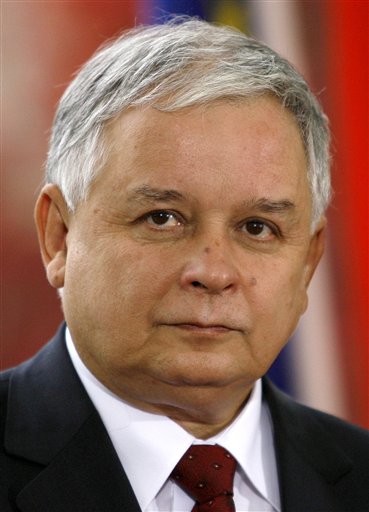
The body of Polish President Lech Kaczynski is to lie in state in the capital Warsaw as the nation mourns the victims of the Smolensk air crash.
He and 95 others, including many top defence officials and public figures, died when their jet crashed en route to a war memorial service in Russia.
Russia is also marking a day of mourning, as relatives arrive in Moscow to try to identify the bodies of the victims.
Duncan Kennedy reports.
Source:BBC
He and 95 others, including many top defence officials and public figures, died when their jet crashed en route to a war memorial service in Russia.

Russia is also marking a day of mourning, as relatives arrive in Moscow to try to identify the bodies of the victims.
Duncan Kennedy reports.
Source:BBC
Poland Mourns Death of Leaders, But Life Goes On
Poland is preparing for state funerals for President Lech Kaczynski and his wife, and is awaiting the repatriation of the bodies of many of its political and military elite - all killed in a plane crash in western Russia on Saturday. Many Poles are slowly coming to grips with this tragedy.
More vigils and tributes - hundreds of people crowded into the Church of Saint Anna in central Warsaw for a special mass for those killed in the crash.
Many mourners young people, mostly students who earlier had marched silently through the city carrying Polish flags and pictures of the President and his wife.
 This young woman, Katherine, says she came in tribute to the country's leaders and because the rector of her university was among those killed.
Nearly 100 people were aboard the flight from Warsaw to the western Russian city of Smolensk. The plane crashed as it tried to land amid heavy fog, killing all onboard - President Lech Kaczynski, his wife Maria and a delegation that included Poland's top military leaders as well as many political and cultural figures.
They were on their way to attend a memorial service to commemorate the murder of some 22,000 Polish military officers and civilians who were massacred by the Soviet Union's secret police during World War II.
Jacek Kucharczyk is President of the Institute of Public Affairs in Warsaw. He says Saturday's plane crash has shocked the nation, but that it has not sparked a political crisis.
"I think that the reaction to this disaster was very quiet and peaceful, and people wanted to mourn the dead above their political views and how they evaluated the President and his party," said Jacek Kucharczyk. "There didn't seem to be any sense that the country is in a fragile situation that institutions aren't working."
As the Polish Constitution mandates, the speaker of parliament has taken on the role of interim president and new elections are to be scheduled within the next 2.5 months.
Meanwhile life is slowly returning to normal. Shops are open; people are at work. But many Poles are also asking questions such as why so many of the country's political leaders were traveling on one plane and why, if as Russian authorities say, the pilot ignored warnings against trying to land in poor weather conditions.
But for now many Poles are seeking comfort in candlelight vigils and in church services.
Source: voanews.com/
More vigils and tributes - hundreds of people crowded into the Church of Saint Anna in central Warsaw for a special mass for those killed in the crash.
Many mourners young people, mostly students who earlier had marched silently through the city carrying Polish flags and pictures of the President and his wife.

Nearly 100 people were aboard the flight from Warsaw to the western Russian city of Smolensk. The plane crashed as it tried to land amid heavy fog, killing all onboard - President Lech Kaczynski, his wife Maria and a delegation that included Poland's top military leaders as well as many political and cultural figures.
They were on their way to attend a memorial service to commemorate the murder of some 22,000 Polish military officers and civilians who were massacred by the Soviet Union's secret police during World War II.
Jacek Kucharczyk is President of the Institute of Public Affairs in Warsaw. He says Saturday's plane crash has shocked the nation, but that it has not sparked a political crisis.
"I think that the reaction to this disaster was very quiet and peaceful, and people wanted to mourn the dead above their political views and how they evaluated the President and his party," said Jacek Kucharczyk. "There didn't seem to be any sense that the country is in a fragile situation that institutions aren't working."
As the Polish Constitution mandates, the speaker of parliament has taken on the role of interim president and new elections are to be scheduled within the next 2.5 months.
Meanwhile life is slowly returning to normal. Shops are open; people are at work. But many Poles are also asking questions such as why so many of the country's political leaders were traveling on one plane and why, if as Russian authorities say, the pilot ignored warnings against trying to land in poor weather conditions.
But for now many Poles are seeking comfort in candlelight vigils and in church services.
Source: voanews.com/
Katyn anniversary tragedy appears to be uniting Russia and Poland
Katyn has symbolised bitter division between Poland and Russia for 70 years. Now the new tragedy associated with its name appears to have united them to an extent unprecedented since the Second World War massacre.
 The outpouring of Russian sympathy for grieving Poles, at official and street levels, may have done more in 48 hours to erode mutual suspicion than any amount of diplomacy since Poland emerged from Moscow’s shadow after the collapse of the Soviet Eastern Bloc.
Russians traditionally celebrate April 12 as Cosmonauts’ Day, in honour of Yuri Gagarin, the first man in space. But yesterday was a day of mourning, with flags at half mast in Moscow. Hundreds of people, many close to tears, laid flowers and lit candles outside the Polish Embassy and at the site in Smolensk where the presidential jet crashed on Saturday, killing all 96 on board.
The government newspaper Rossiiskaya Gazeta called the catastrophe “our common sorrow” and the opposition Novaya Gazeta declared in Polish: “We are with you.” President Medvedev and Vladimir Putin, the Prime Minister, have been visibly moved by the enormity of the latest loss of Polish life on Russian soil.
Poland and other states long used to regarding Russia as an aggressive bear have suddenly witnessed a more humane face of their former bête noire. After placing roses before a portrait of President Kaczynski and his wife, Maria, at the Polish Embassy, Mr Medvedev wrote in the book of condolences that the “dreadful tragedy . . . has shocked the Russian people”. He added: “The loss left an unfillable void. We are grieving together with you.”
Mr Putin’s embrace of Donald Tusk, his Polish counterpart, at the crash site has become a symbol of the new entente. He told the Russian Cabinet that the country was “grieving together with the Poles”.
Mr Putin has promised a full investigation by Russian and Polish experts working together in a clear attempt to dispel even a shadow of suspicion over the causes of the crash. Any unanswered questions would provide fertile grounds for conspiracy theories that each side knows could wreck hopes for lasting rapprochement.
History is not easily overcome and everyday politics has a habit of corroding goodwill once the initial shock of a tragedy has worn off. It remains too early to say whether Russia and Poland are entering a new era of improved understanding or merely expressing common emotions at an accident whose impact will fade with time.
For now, shared grief over the “second Katyn tragedy” has created more space for Russians to consider the first. State television broadcast Andrzej Wajda’s film about the 1940 massacre of 22,000 officers for the second time in ten days on Sunday, presenting viewers with a Polish history lesson that the Soviet Union had lied about for half a century. The state news agency Ria-Novosti also published the speech that Mr Kaczynski, a vehement critic of the Kremlin, was to have given in Katyn to mark the 70th anniversary. It contained a poignant appeal for reconciliation days after Mr Putin and Mr Tusk held the first joint memorial service at the site of the slaughter.
“Katyn became a painful wound of Polish history, which poisoned relations between Poles and Russians for decades. Let’s make the Katyn wound finally heal and cicatrise,” Mr Kaczynski had planned to say. “We are on the way to do it. We, Poles, appreciate what Russians have done in the past years. We should follow the path which brings our nations closer.”
Source:timesonline.co.uk/

Russians traditionally celebrate April 12 as Cosmonauts’ Day, in honour of Yuri Gagarin, the first man in space. But yesterday was a day of mourning, with flags at half mast in Moscow. Hundreds of people, many close to tears, laid flowers and lit candles outside the Polish Embassy and at the site in Smolensk where the presidential jet crashed on Saturday, killing all 96 on board.
The government newspaper Rossiiskaya Gazeta called the catastrophe “our common sorrow” and the opposition Novaya Gazeta declared in Polish: “We are with you.” President Medvedev and Vladimir Putin, the Prime Minister, have been visibly moved by the enormity of the latest loss of Polish life on Russian soil.
Poland and other states long used to regarding Russia as an aggressive bear have suddenly witnessed a more humane face of their former bête noire. After placing roses before a portrait of President Kaczynski and his wife, Maria, at the Polish Embassy, Mr Medvedev wrote in the book of condolences that the “dreadful tragedy . . . has shocked the Russian people”. He added: “The loss left an unfillable void. We are grieving together with you.”
Mr Putin’s embrace of Donald Tusk, his Polish counterpart, at the crash site has become a symbol of the new entente. He told the Russian Cabinet that the country was “grieving together with the Poles”.
Mr Putin has promised a full investigation by Russian and Polish experts working together in a clear attempt to dispel even a shadow of suspicion over the causes of the crash. Any unanswered questions would provide fertile grounds for conspiracy theories that each side knows could wreck hopes for lasting rapprochement.
History is not easily overcome and everyday politics has a habit of corroding goodwill once the initial shock of a tragedy has worn off. It remains too early to say whether Russia and Poland are entering a new era of improved understanding or merely expressing common emotions at an accident whose impact will fade with time.
For now, shared grief over the “second Katyn tragedy” has created more space for Russians to consider the first. State television broadcast Andrzej Wajda’s film about the 1940 massacre of 22,000 officers for the second time in ten days on Sunday, presenting viewers with a Polish history lesson that the Soviet Union had lied about for half a century. The state news agency Ria-Novosti also published the speech that Mr Kaczynski, a vehement critic of the Kremlin, was to have given in Katyn to mark the 70th anniversary. It contained a poignant appeal for reconciliation days after Mr Putin and Mr Tusk held the first joint memorial service at the site of the slaughter.
“Katyn became a painful wound of Polish history, which poisoned relations between Poles and Russians for decades. Let’s make the Katyn wound finally heal and cicatrise,” Mr Kaczynski had planned to say. “We are on the way to do it. We, Poles, appreciate what Russians have done in the past years. We should follow the path which brings our nations closer.”
Source:timesonline.co.uk/
Subscribe to:
Posts (Atom)